

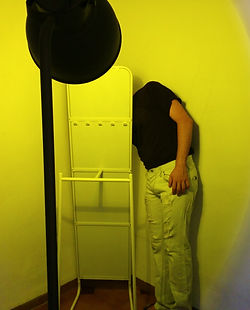
Confronting Denial in Hepatitis C
(Negación ante la Hepatitis C)
Valencia, 2014
Mirror, yellow–light lamp, bulb, 250 × 250 × 200 cm
Created thanks to the Cátedra Arte y Enfermedades (Art & Illness Grant), Faculty of Fine Arts, Polytechnic University of Valencia, Part of the project “Perspectives – Art, Liver Diseases and Me”
Confronting denial in Hepatitis C is an installation that explores one of the most emotionally complex stages of living with Hepatitis C: the moment when a person turns away from diagnosis and avoids treatment out of fear, stigma, or exhaustion.
During the development of the project, Mónica, the person whose experience inspired this piece, moved from years of denial toward finally confronting the illness. Although she still feared the side effects of treatment, she chose to begin the healing process and face her condition directly.
Concept: Light, Reflection, and the Refusal to See Oneself
The installation uses two key elements:
-
a yellow–light lamp, symbolizing healing, medical intervention, and the fear of side effects
-
a mirror turned toward the corner, refusing to reflect the viewer
Together, they describe the psychological space of denial. The yellow light becomes a metaphor: illumination as treatment, illumination as exposure, and illumination as stigma. Light both reveals and “marks” the body, much like illness does.
The mirror, facing the wall, refuses identity. It denies the viewer, just as a patient in denial avoids their own reflection, diagnosis, or vulnerability.
The piece reflects on how society often stigmatizes illness and those who suffer from it. To point at the disease is, too often, to point at the person. This installation argues against that stigma and invites the audience to reconsider their own assumptions.
The Viewer’s Role: Becoming the Patient
As you walk into the installation, you inevitably step into the role of the patient. The yellow light touches your body, “marking” you. When you search for your reflection, the mirror denies you. In that moment, the work reminds us that anyone can be affected by Hepatitis C.
Faced with the installation, you stand before a symbolic choice:
-
Turn on the lamp, accepting the treatment even if the light exposes you.
-
Rotate the mirror, turning it away from the wall to finally face your own reflection.
Both actions represent the psychological journey from denial toward acknowledgement, healing, and destigmatization.
The Conversations Behind the Work
The most meaningful part of the entire process came through long conversations with Mónica, where she revealed how her perception of the disease had shifted over time.
When we first met, she described Hepatitis C only as a side effect of another illness: addiction. But as we continued talking, I began to notice how consistently she avoided naming the disease directly. There was fear, vulnerability, and a deep sense of stigma. To her, acknowledging the illness meant accepting a label: “I am sick.”
She preferred to look away, suppressing the anxiety about what she called “a horrible treatment”. But somewhere along the process, something changed. She decided to stop turning her back on the illness and, in her own words, to “look at it head-on.” This installation is a reflection of that moment.

Negación ante la Hepatitis C, Juan Carlos Rosa Casasola, 2014. Imagen cedida por la Cátedra Arte y Enfermedades.